If you’ve spent any time around hikers or national park content, you’ve probably heard the phrase “Leave No Trace.” It gets tossed around so often that it’s easy to nod along without really thinking about what it means, or why it exists in the first place.
Here’s the short version: Leave No Trace isn’t a suggestion. It’s the reason the places we love to visit are still going to be there, in something close to their natural state, for the next person who walks the trail after you.
The long version is a little more interesting, and honestly, a little more personal.
Where Leave No Trace Actually Came From
Leave No Trace isn’t just a nice phrase someone came up with for a trailhead sign. It started as a real response to a real problem: national parks were getting loved to death.
As visitation grew, so did the damage — trampled meadows, eroded trails, campfire scars in places that had never seen one, wildlife that had started associating humans with food. Land management agencies and outdoor organizations eventually formalized a set of principles to help visitors understand how to enjoy these places without slowly wearing them down.
Today, those principles are usually broken into seven parts. Some of them are obvious. A few of them might surprise you.
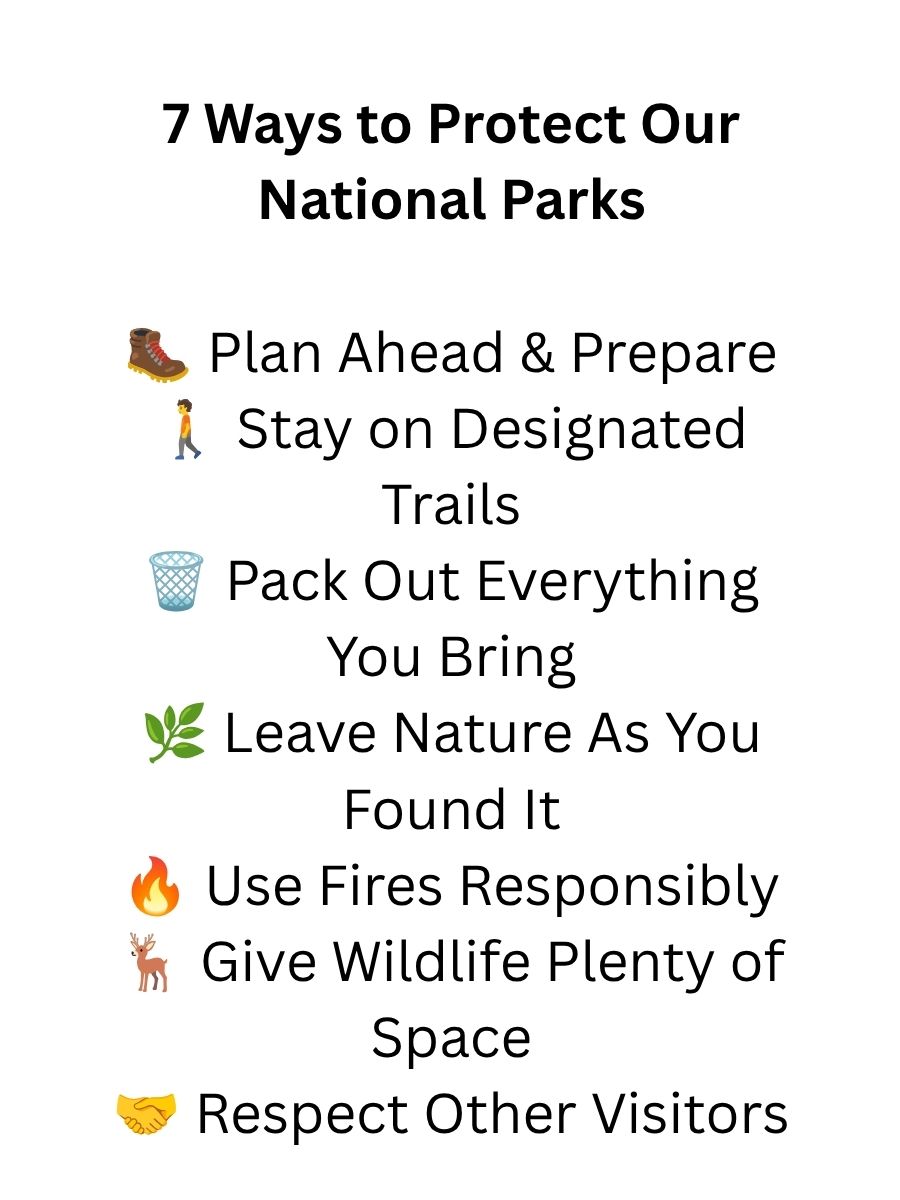
The 7 Principles (And What They Actually Mean in Practice)
1. Plan Ahead and Prepare
This one sounds like basic trip planning, but it’s actually a Leave No Trace principle for a reason. When you’re prepared — you know the trail conditions, you have the right gear, you understand the regulations for that specific park — you’re far less likely to make a decision that damages the environment out of desperation. Getting caught unprepared is how people end up cutting switchbacks, building unauthorized fires, or leaving trash behind because they didn’t pack out what they needed to.
2. Travel and Camp on Durable Surfaces
This is the “stay on the trail” rule, and it’s probably the one people break most often, usually without realizing the damage they’re doing. Trails exist because that specific path can handle repeated foot traffic. The ground around it often can’t.
In alpine meadows, a single shortcut through wildflowers can take decades to recover. In desert parks like Arches or Canyonlands, you’ll often see dark, bumpy soil called cryptobiotic soil — it looks unremarkable, but it’s a living ecosystem that can take 50 years or more to recover from a single footprint.
3. Dispose of Waste Properly
Pack it in, pack it out — including things people don’t always think about, like fruit peels and food scraps. They may be biodegradable eventually, but “eventually” can mean years in a dry climate, and in the meantime, they attract wildlife to areas they shouldn’t be. This principle also covers human waste, which matters more than people want to think about, especially in high-traffic backcountry areas.
4. Leave What You Find
That perfect rock, that unusual piece of petrified wood, that antler shed on the side of the trail — leave it where it is. It sounds small, but multiply that “just one” by the millions of people who visit these parks every year, and you start to understand why removing natural or historical objects, even in tiny amounts, adds up to real loss over time.
5. Minimize Campfire Impact
Campfires feel like an essential part of the outdoor experience, but they’re also one of the most damaging if done carelessly, and one of the leading causes of human-caused wildfires in and around national parks. Following fire regulations, using established fire rings, and fully extinguishing fires isn’t just etiquette. It’s often the difference between a great trip and a preventable disaster.
6. Respect Wildlife
This is the one most people already know, but it’s worth restating: feeding wildlife, approaching for photos, or leaving food accessible teaches animals to associate humans with an easy meal. That almost never ends well for the animal, and sometimes it doesn’t end well for the person either.
7. Be Considerate of Other Visitors
The last principle is less about the environment and more about the experience — keeping noise down, yielding the trail appropriately, not crowding a viewpoint someone else is trying to enjoy. National parks are shared spaces, and a huge part of what makes them special is the ability to feel a little bit alone in nature, even when you’re not actually alone.
Why This Actually Matters (Beyond “Because You’re Supposed To”)
Here’s the thing that doesn’t get said enough: none of these principles exist because someone wants to make your trip more complicated. They exist because national parks are being loved by more people than ever before, and that love, unmanaged, has consequences.
Some of the damage from ignoring these principles isn’t visible right away. A trampled meadow doesn’t look destroyed the day it happens — it just looks like grass got walked on. It’s the cumulative effect, thousands of people making that same small decision, that turns a resilient landscape into a scarred one. And by the time it’s visible, it’s often too late to reverse in any timeframe that matters to the people currently visiting.
The parks we have today only exist in their current condition because, for the most part, people have followed these principles well enough to keep the damage from outpacing the recovery. That balance is more fragile than it looks.
You Don’t Have to Be Perfect. You Just Have to Be Aware.
I’ll be honest with you: I don’t think anyone follows Leave No Trace perfectly, all the time. I’ve stepped off a trail for a photo. I’ve probably made small mistakes I didn’t even register in the moment.
The goal isn’t perfection. It’s awareness — understanding why these guidelines exist, so that when you’re standing at a trail junction deciding whether to take the “shortcut,” or debating whether it’s really a big deal to get a little closer to that elk for a photo, you’re making that decision with the full picture instead of without it.
That’s really what Leave No Trace comes down to: not a rulebook, but a mindset. Treating these places like they’re worth protecting, because they are, and because the next person walking that trail deserves to see them the way you did.